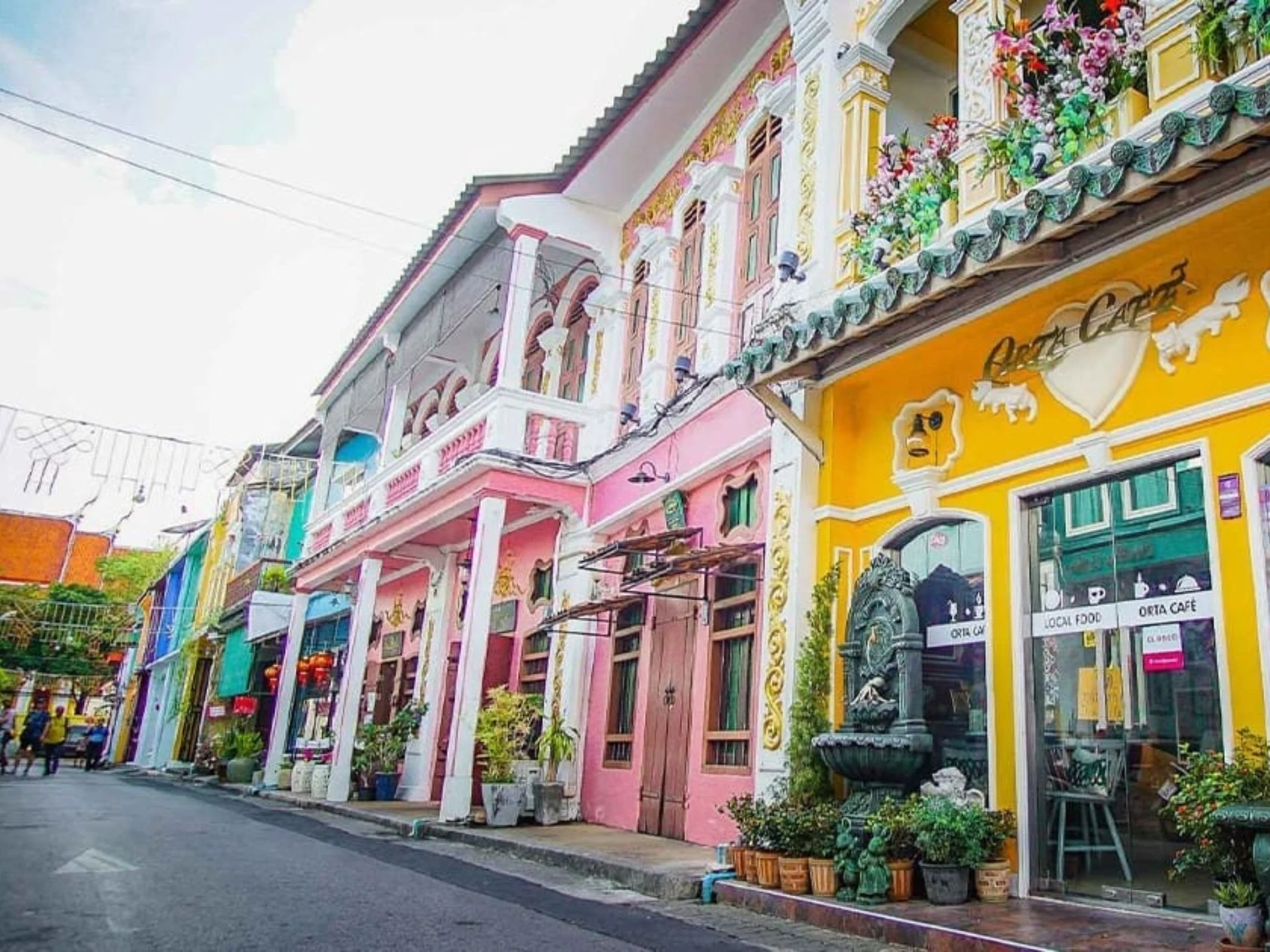
In the 19th century Phuket's economy ran on tin, and that money built Phuket Town. Chinese merchants put up two-storey Sino-Portuguese shophouses, and many of them still line Thalang Road, Dibuk Road and Soi Romanee today.
Central Phuket now runs to the rhythm of the working week rather than the tourist season. Hospitals, schools, the courts, the immigration office and the main shopping centres are all here, and every morning the staff of the west-coast hotels set off from here to work. For a buyer, that means steady demand for long-term rentals and prices well below those in the beach areas.
Central Phuket at a glance
✓ Location: the eastern side of the island, between Patong to the west and Phang Nga Bay to the east, with Chalong and Rawai to the south
✓ Airport: around 30 km (19 miles) via Highway 402, depending on where you are in the area
✓ Beaches: the east coast is lined with mangroves and piers; the nearest swimming beach is Patong, about 13–15 km (8–9 miles) away
✓ Schools: British International School Phuket, HeadStart, Kajonkiet International School, QSI International School of Phuket
✓ Shopping: Central Phuket (Floresta and Festival buildings), Robinson, Big C, Makro, Lotus's, Premium Outlet
✓ Healthcare: Bangkok Hospital Phuket, Vachira Phuket Hospital, Mission Hospital
✓ Yachting: Royal Phuket Marina and Boat Lagoon, with ferries to Phi Phi from Rassada Pier
✓ Golf: Loch Palm and Red Mountain, 18 holes each
Three sides of central Phuket
The Old Town and business district
✓ Historic streets, markets, government offices and bank branches
✓ Apartments here are rented by doctors, teachers, and company and hotel staff
✓ Buyers choose studios and one-bedroom apartments to let on long-term tenancies
The east coast marinas
✓ Gated communities, lakes, yacht moorings and an international school in the next neighbourhood
✓ Home to expat families and yacht owners who live on the island year-round
✓ Buyers choose pool villas and houses in secure gated communities
The golf valley between town and Patong
✓ Two golf clubs, green hills and the road over the pass to Patong
✓ Demand comes from west-coast resort staff and golfers
✓ Buyers choose condominium apartments and villas overlooking the fairways
What is in the catalogue and what it costs
The selection centres on two formats. Condominium apartments are bought to let on annual tenancies or to live in. Villas and houses in gated communities suit families who want a school and a hospital nearby, and investors looking for an expat tenant.
Resale apartments start from about ฿1.7 million (£38,000), and new developments from ฿2.5 million (£56,000). The median apartment price across central Phuket is around ฿3.2 million (£72,000), or roughly ฿86,000 per sqm (£1,940; about ฿8,000 or £180 per sq ft). On average a studio costs ฿2.4 million (£54,000), a one-bedroom apartment around ฿3 million (£68,000) and a two-bedroom around ฿4.9 million (£110,000).
A house in a gated community averages ฿8.8 million (£198,000) and a villa with its own pool around ฿10.5 million (£237,000). New premium villas sell from ฿15–16 million (£338,000–361,000), while club developments by the marinas and lakes, such as Fortuna Lakeside, 1 km from British International School, start at ฿35 million (£790,000).
What drives rental returns
In central Phuket, income comes from long-term letting. Tenants sign for 6–12 months, so occupancy depends little on the tourist season, and the property is spared the wear of constant guest turnover.
There are no fixed yields on this market, and we do not promise one on any property. The result depends on the purchase price, the layout and furnishing, the distance to schools, hospitals and workplaces, and the service charge and sinking fund contributions. Property values and rental income can go down as well as up. A KVARIS adviser will run the numbers for a specific property during a consultation.
How foreigners can buy property
A foreign buyer can own a condominium apartment on a Freehold title, full ownership under Thai law, within the 49% foreign quota of the building's floor area. Villas and the land beneath them are usually bought on Leasehold: a lease of up to 30 years registered with the Land Department. Thai law does not automatically guarantee the renewals promised under 30+30 schemes. A third route, a Thai company, requires genuine business activity.
Buying a home does not in itself grant a visa; longer stays are arranged under separate visa programmes.
What to check before you buy
✓ The land title: Chanote (Nor Sor 4 Jor)
✓ The developer's entry in the DBD register and its completed projects
✓ The building permit and EIA (environmental impact assessment) status
✓ Available foreign quota in the specific building
✓ The service charge and sinking fund contributions
✓ For homes by the marinas and lakes: access to the plot and ground level above the water line
How the purchase works
Reservation with a deposit, legal due diligence on the property, a sale and purchase agreement with a payment schedule, registration at the Land Department, then handover.