Article about property taxes in Thailand for foreigners: buying, owning, letting and selling
Property taxes in Thailand for foreigners: buying, owning, letting and selling
Foreign owners of property in Thailand meet taxes at four stages: when they buy, own, let and sell.
What does a foreigner pay at the Land Department when buying an apartment? How much tax falls due each year, and how much is withheld from rental income? And why do the transfer costs come to 1% of the price for one buyer and 6.3% for another? We work through every tax on one example apartment priced at ฿7,600,000 (€201K / $225K). Swap in your own price and the formulas give you your own figure.
Buying property in Thailand costs more than the price on the listing. Taxes and fees arise when you buy, own, let and sell: the transfer fee, Specific Business Tax or stamp duty, withholding tax, the annual land and building tax and tax on rental income. The total depends on the type of transaction, who the seller is, how long they have owned the property, its appraised value and whether you live in it, let it or hold it as an investment.
Below we cover what is paid at the Land Department, how costs differ between freehold and leasehold, when a sale triggers tax and how rental income is taxed. Each stage comes with a worked example, and a separate section explains how the house registration book (Tabien Baan) affects your tax bill.
1. In brief
Stage
What is paid
Rate
Buying freehold
Transfer fee
2% of the appraised value, usually split 50/50 with the seller
Buying leasehold
Lease registration fee and stamp duty
1.1% of the total rent for the full term
Owning
Land and building tax
0% for a main home up to ฿10,000,000; 0.02% for other homes; from 0.3% for nightly lets
Letting
Income tax
5% or 15% withheld; final tax on a scale from 0% to 35%
Selling within 5 years
Specific Business Tax and withholding tax
3.3% plus tax by formula
Selling after 5 years, or with 1 year in the house book
Stamp duty and withholding tax
0.5% plus tax by formula
Inheritance
Inheritance tax
5% or 10% on the amount above ฿100,000,000
2. Freehold and leasehold: why ownership type changes the fees
What you pay depends on how the property is held. Freehold means outright ownership, and on completion the Land Department transfers title to you. Leasehold means a registered lease of up to 30 years: the lease agreement is registered instead, and different fees apply.
3. The example apartment used in every calculation
Every calculation in this article uses the same apartment:
price: ฿7,600,000 (€201K / $225K);
Land Department appraised value: ฿7,600,000;
rental guarantee from the developer: 7% a year;
sold 3 years and 6 months after purchase.
A note on the appraised value. The Land Department (Land Office) values apartments from its own register, and its figure is usually below the market price. We have set it equal to the price so the sums are easy to follow. Ask the Land Department or the lawyer handling your purchase for the real appraised value of your unit: with it, your costs will come out lower.
How to use the example: replace ฿7,600,000 with the price of your apartment and take the rates from the tables below. Euro and dollar amounts are for reference only.
4. Taxes and fees when you buy
Transfer fee
The main cost of a freehold purchase is 2% of the appraised value. The Land Department collects it on the day the transfer is registered, and the rate is the same for Thai and foreign buyers.
The law does not say who pays the fee. The parties set the split in the contract and usually share it 50/50.
A developer states how costs are split in the sale and purchase agreement: check this clause before you reserve.
The seller’s taxes (Specific Business Tax of 3.3% and withholding tax) fall on the seller by law. Some developers absorb them; others pass them on to the buyer.
The 0.01% reduction: who qualifies
From 1 July 2026 to 30 June 2027, the transfer fee and the mortgage registration fee are cut to 0.01%. The conditions:
the buyer is an individual with Thai citizenship;
the price, the appraised value and the mortgage amount are each no more than ฿7 million (€185K / $207K).
A foreign buyer pays the full 2%. Sellers still benefit: a Thai buyer pays less for an apartment priced up to ฿7 million, so such an apartment is easier to sell.
Worked example: buying a freehold apartment from a developer
Step 1. Work out the transfer fee
Formula: appraised value × 2% = fee
Where to find the appraised value: in the Land Department documents (in our example it equals the price)
7,600,000 × 2% = ฿152,000 (€4.0K / $4.5K)
Step 2. Split the fee as the contract says
Formula: fee ÷ 2 = buyer’s share
152,000 ÷ 2 = ฿76,000 (€2.0K / $2.3K)
Step 3. Work out the seller’s taxes
Specific Business Tax: 7,600,000 × 3.3% = ฿250,800 (€6.6K / $7.4K)
Withholding tax for a corporate seller: 7,600,000 × 1% = ฿76,000 (€2.0K / $2.3K)
Totals for the transaction
Payment
Rate
Amount
Transfer fee
2%
฿152,000
Specific Business Tax (SBT)
3.3%
฿250,800
Withholding tax
1%
฿76,000
All transaction costs
6.3%
฿478,800
Buyer pays if the developer covers its taxes and splits the fee 50/50
1%
฿76,000
Buyer pays if all costs are passed on
6.3%
฿478,800
In money terms, the buyer of this apartment pays between ฿76,000 (€2.0K / $2.3K) and ฿478,800 (€13K / $14K), depending on the contract.
A freehold apartment from a developer usually costs more than the same unit on leasehold, so compare the full price including fees. On the resale market the seller is usually an individual, and their taxes are calculated differently: see section 7.
Worked example: buying a leasehold apartment
On a leasehold purchase two charges apply to the total rent for the full lease term: lease registration at 1% and stamp duty at 0.1%.
Step 1. Find the total rent for the full term
Where to find it: in the lease agreement
In our example: ฿7,600,000 for 30 years
Step 2. Work out the lease registration fee
Formula: total rent × 1% = fee
7,600,000 × 1% = ฿76,000 (€2.0K / $2.3K)
Step 3. Work out the stamp duty
Formula: total rent × 0.1% = duty
7,600,000 × 0.1% = ฿7,600 (€201 / $225)
Step 4. Add up and split
76,000 + 7,600 = ฿83,600 (€2.2K / $2.5K), or 1.1%
Split 50/50, the buyer pays 83,600 ÷ 2 = ฿41,800 (€1.1K / $1.2K)
Some contracts put the whole 1.1% on the buyer
A lease longer than 3 years must be registered with the Land Department. Without registration it is enforceable for the first 3 years only.
5. Land and building tax while you own the property
The annual land and building tax was introduced by the Land and Building Tax Act B.E. 2562 and has applied since 2020. It is charged on the appraised value, not the market price. Whoever owns the property on 1 January pays, and the local authority sends the bill.
Tax rates in 2026
The rates were set by a Royal Decree in 2021 and did not change in 2026. The main-home relief applies if the owner is listed in the house registration book at the property’s address on 1 January.
Type of home
Tax-free
Rate above the threshold
Main home; owner of the land and house listed in the house book
up to ฿50,000,000
0.03% from ฿50M to ฿75M; 0.05% from ฿75M to ฿100M; 0.1% above ฿100M
Main home; owner of the building only (apartment, house on leased land) listed in the house book
up to ฿10,000,000
0.02% from ฿10M to ฿50M; then 0.03%, 0.05% and 0.1%
Other homes: apartment let for a month or more, second home, owner not listed in the house book
no threshold
0.02% up to ฿50M; 0.03% from ฿50M to ฿75M; 0.05% from ฿75M to ฿100M; 0.1% above ฿100M
Nightly lets, commercial use
no threshold
from 0.3%
The 0.3% rate applies to commercial use, not to a home without a house book entry.
Some local authorities apply the ฿50 million threshold, rather than ฿10 million, to apartments with a house book entry. If your apartment is worth more than ฿10 million, check which threshold your authority uses.
Under leasehold the owner is legally liable for the tax, but leases often pass it to the tenant. Check this clause before you sign.
Worked example: annual tax on a ฿7.6 million apartment
Option 1. Main home, owner listed in the house book
Compare the appraised value with the threshold: ฿7,600,000 is below ฿10,000,000
Tax: ฿0
Option 2. Apartment let out, or owner not listed in the house book
Formula: appraised value × 0.02% = tax for the year
7,600,000 × 0.02% = ฿1,520 a year (€40 / $45)
6. Tax on rental income
Most apartments on Phuket are bought to let, so this section applies to most owners. Rental income from an apartment in Thailand is subject to Thai income tax wherever the owner lives. The type of ownership makes no difference: the rules for freehold and leasehold are the same.
Resident or non-resident: how to tell
Tax resident: spent 180 days or more in Thailand in the calendar year.
Non-resident: spent fewer than 180 days in Thailand.
If the rent is paid by a company (a developer under a rental guarantee programme or a management company), it withholds tax at the time of payment.
Withholding rate: 5% for residents, 15% for non-residents.
The company issues a withholding certificate (Form 50 Tawi). Keep it: you need it for your tax return and any refund.
Deductions used in the calculation:
standard deduction for letting expenses: 30% of income (or your actual documented expenses instead);
personal allowance: ฿60,000 a year (€1.6K / $1.8K);
allowances for dependants and other reliefs under the Revenue Code.
Personal income tax scale:
Taxable income for the year
Rate
up to ฿150,000
0%
฿150,001 to ฿300,000
5%
฿300,001 to ฿500,000
10%
฿500,001 to ฿750,000
15%
฿750,001 to ฿1,000,000
20%
฿1,000,001 to ฿2,000,000
25%
฿2,000,001 to ฿5,000,000
30%
over ฿5,000,000
35%
Worked example: tax resident
Step 1. Annual rental income
Formula: apartment price × guaranteed rate = income for the year
7,600,000 × 7% = ฿532,000 (€14K / $16K)
Step 2. Tax withheld by the company
Formula: income × 5% = amount withheld
532,000 × 5% = ฿26,600 (€702 / $788)
Step 3. Deduct standard expenses of 30%
532,000 × 30% = ฿159,600
532,000 − 159,600 = ฿372,400
Step 4. Deduct the personal allowance
372,400 − 60,000 = ฿312,400 (€8.3K / $9.3K)
This is your taxable income
Step 5. Apply the scale band by band
Band up to ฿150,000: 0%, tax ฿0
Band from ฿150,001 to ฿300,000: 150,000 × 5% = ฿7,500
Band from ฿300,001 to ฿312,400: 12,400 × 10% = ฿1,240
Tax for the year: 0 + 7,500 + 1,240 = ฿8,740 (€231 / $259)
Step 6. Work out the refund
Formula: tax withheld − tax due = refund
26,600 − 8,740 = ฿17,860 (€472 / $529)
The refund is paid into your bank account once you file a return, or set against next year’s tax
Result for a resident
Income for the year: ฿532,000 (€14K / $16K)
Tax due: ฿8,740 (€231 / $259), about 1.6% of income
Refund: ฿17,860 (€472 / $529)
This holds if the owner has no other income in Thailand. Other income and additional allowances change the result.
Worked example: non-resident
Step 1. Annual rental income
7,600,000 × 7% = ฿532,000 (€14K / $16K)
Step 2. The company withholds 15%
Withholding is charged on the full rent, with no deductions
532,000 × 15% = ฿79,800 (€2.1K / $2.4K)
Step 3. What the owner receives
532,000 − 79,800 = ฿452,200 (€12K / $13K)
A non-resident can file a Thai tax return, have the tax recalculated on the scale and reclaim part of the amount withheld. The refund depends on the allowances you are entitled to, so work it out with a tax adviser before filing.
If you let the apartment yourself
When the tenant is a private individual, nobody withholds tax on the rent.
The owner declares the income by 31 March of the following year, in person or through a lawyer.
Rates, deductions and the scale are the same as in the examples above.
Can you let an apartment by the night?
In an ordinary condominium, nightly lets are not allowed. Under the Hotel Act B.E. 2547, letting a home for less than a month counts as hotel business and requires a licence.
Letting for one month (30 days) or longer is legal.
In some condominiums a separate building holds a hotel licence. It runs a reception desk and a management company, and nightly lets there are legal. Owners of such units receive income under the management programme.
The Cabinet approved in principle a draft accommodation law on 29 September 2026. It does not legalise nightly lets in ordinary condominiums.
Before you buy, ask the developer whether the building holds a hotel licence and what minimum letting period the condominium rules set.
7. Taxes when you sell
Who pays what on a sale
By law the seller pays Specific Business Tax (or stamp duty instead) and withholding tax.
The 2% transfer fee is split as the contract says, usually 50/50.
The Land Department collects all amounts on the day the transfer is registered.
Fix the split of every payment in the contract before you reserve, and there will be no surprises on completion day.
Specific Business Tax or stamp duty
The seller pays one of the two, never both.
Situation
Payment
Rate
Basis
Owned for less than 5 years
Specific Business Tax (SBT)
3.3% (3% tax plus a local levy of 10% of the tax)
Higher of the appraised value and the sale price
Owned for 5 years or more
Stamp duty
0.5%
Higher of the two
Owned for less than 5 years, but the seller has been listed in the house book at the property’s address for at least 1 year from purchase
Stamp duty
0.5%
Higher of the two
Royal Decree No. 342 also exempts from SBT a seller who:
inherited the property;
transfers it free of charge to their legitimate children (adopted children excluded);
passes it on by inheritance to legal heirs.
Withholding tax
A corporate seller pays 1% of the higher of the two values. For an individual seller, the tax is calculated by formula from the appraised value and the holding period: neither the purchase price nor the sale price enters the formula.
Deduction by holding period:
Holding period
Deduction
1 year
92%
2 years
84%
3 years
77%
4 years
71%
5 years
65%
6 years
60%
7 years
55%
8 years or more
50%
Tax scale on a sale:
Base per year
Rate
up to ฿300,000
5%
฿300,001 to ฿500,000
10%
฿500,001 to ฿750,000
15%
฿750,001 to ฿1,000,000
20%
฿1,000,001 to ฿2,000,000
25%
฿2,000,001 to ฿5,000,000
30%
over ฿5,000,000
35%
Three rules of the calculation:
a part year counts as a full year: 3 years and 6 months count as 4 years;
no more than 10 years of ownership are taken into account;
the tax cannot exceed 20% of the sale price.
The scale looks like the ordinary income tax scale, but it has no 0% band: the first ฿300,000 is taxed at 5%.
Worked example: selling after 3.5 years
Step 1. Holding period
3 years and 6 months round up to 4 years
Step 2. Find the deduction in the table
4 years = 71% deduction
Step 3. Work out the base for the whole period
Formula: appraised value − (appraised value × deduction) = base
7,600,000 × 71% = ฿5,396,000
7,600,000 − 5,396,000 = ฿2,204,000 (€58K / $65K)
Step 4. Divide the base by the number of years
Formula: base ÷ years = base per year
2,204,000 ÷ 4 = ฿551,000 (€15K / $16K)
Step 5. Apply the scale band by band
Band up to ฿300,000: 300,000 × 5% = ฿15,000
Band from ฿300,001 to ฿500,000: 200,000 × 10% = ฿20,000
Band from ฿500,001 to ฿551,000: 51,000 × 15% = ฿7,650
฿170,600 is below the cap, so the seller pays ฿170,600
What the seller pays: two scenarios
The seller has owned the apartment for 3.5 years and splits the transfer fee with the buyer 50/50.
Payment
Scenario A: seller not listed in the house book
Scenario B: seller listed in the house book for over 1 year
Half the transfer fee (1%)
฿76,000
฿76,000
Specific Business Tax, 3.3%
฿250,800
not payable
Stamp duty, 0.5%
not payable
฿38,000
Withholding tax
฿170,600
฿170,600
Total
฿497,400, 6.5% of the price
฿284,600, 3.7% of the price
In scenario A the seller pays ฿497,400 (€13K / $15K), in scenario B ฿284,600 (€7.5K / $8.4K).
The house book entry saves the seller ฿212,800 (€5.6K / $6.3K).
The buyer of this apartment does not qualify for the 0.01% reduction even with Thai citizenship: the price is above ฿7 million.
On the sale of a leasehold apartment, the lease is assigned to the buyer and the assignment is registered. The seller’s fees and taxes then depend on the lease terms, so have a lawyer calculate them for the specific deal.
8. Inheritance tax
In Thailand inheritance tax is paid by the heir when the inheritance received is worth more than ฿100 million (€2.64M / $2.96M). Only the part above ฿100 million is taxed:
5% for parents, children and grandchildren;
10% for other heirs.
An apartment at ฿7.6 million falls well below the threshold. And when an inherited apartment is sold, no Specific Business Tax is payable.
9. The house registration book (Tabien Baan) and tax relief
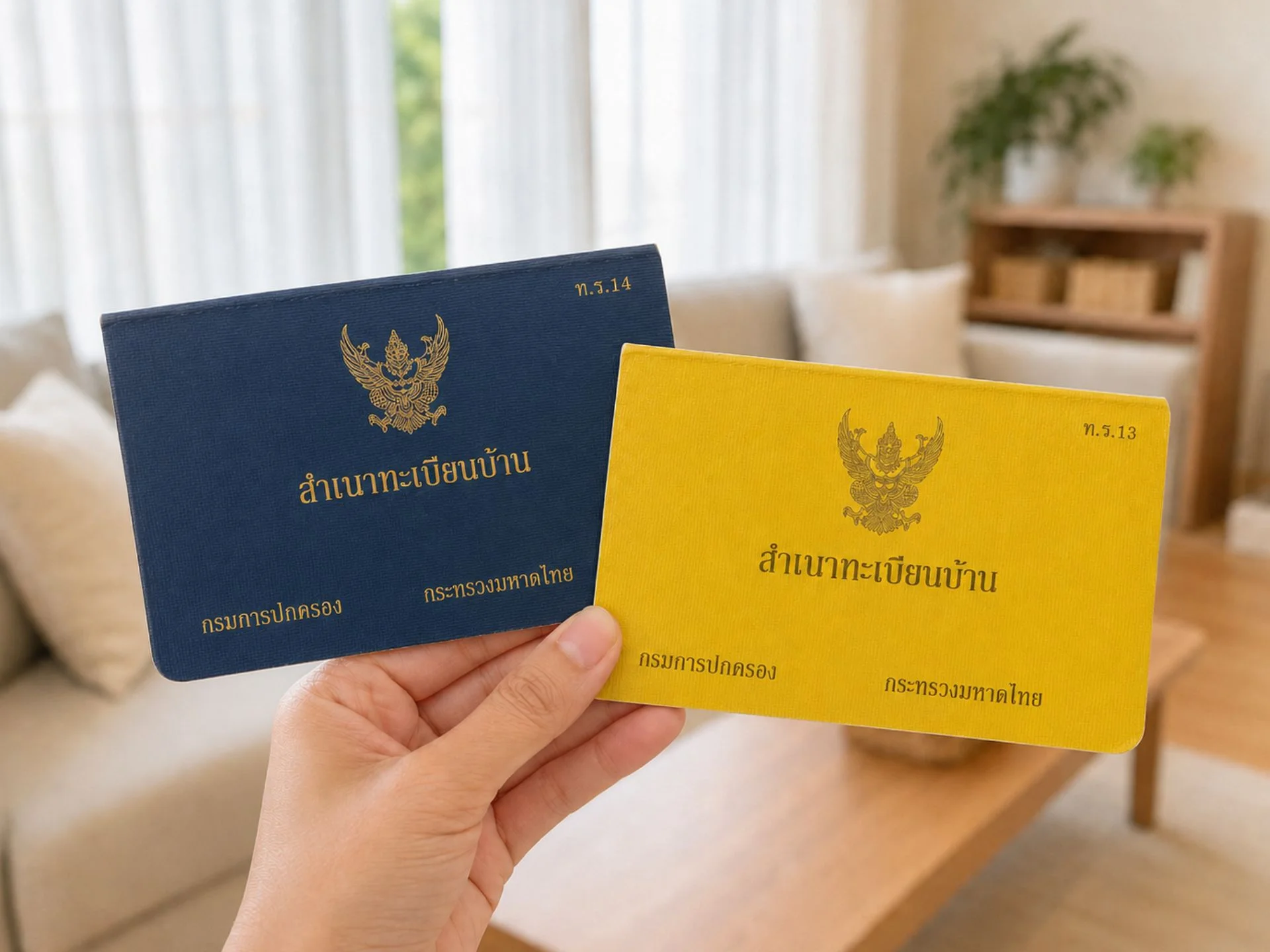
The Tabien Baan (house registration book) records an address and the people registered at it. It does not prove ownership.
The blue book (Tor Ror 14) is for Thai citizens and foreigners with permanent residence.
The yellow book (Tor Ror 13) is for foreigners on a long-term visa who live at that address. You do not have to own the home to be listed: a registered lease also qualifies.
The yellow book is issued by the district office for the property’s address, which also confirms the list of documents.
Tax relief that comes with the yellow book:
exemption from land and building tax on a main home worth up to ฿10 million, if you are listed on 1 January;
exemption from the 3.3% Specific Business Tax on a sale, if the owner has been listed for at least a year from the date of purchase.
10. Checklist: tax points to check before the deal
Ask the Land Department for the appraised value of the apartment: almost every fee is calculated from it.
Write into the contract who pays each fee and tax.
For freehold, arrange the FET in advance: the bank’s confirmation that the funds came from abroad.
For leasehold, check who pays the land and building tax under the lease.
If you are buying to let, ask the developer about the hotel licence and the minimum letting period.
If you plan to live in the apartment, get the yellow house book before 1 January.
Keep the withholding certificates on your rental income (Form 50 Tawi).
Freehold and leasehold apartments, including units with rental guarantee programmes, are listed in our selection of projects. A KVARIS manager will calculate the fees and taxes for your chosen apartment, free of charge for the buyer.
This article is for general information only. Thai law and government practice change, so check current rates and requirements with a Thai lawyer before any transaction. Euro and dollar amounts are rounded and given for reference.
Author: KVARIS press office
FAQ
01
How much will I pay in taxes and fees when buying an apartment in Thailand?
Foreign buyers pay the same rates as Thai buyers. For a freehold apartment from a developer, the costs come to between 1% and 6.3% of the appraised value, depending on the contract: on a ฿7.6 million apartment that means ฿76,000 (€2.0K / $2.3K) to ฿478,800 (€13K / $14K). Quotes of 1%, 3.15% or 6.3% are the same 6.3% total split differently between developer and buyer, so ask for the split in writing before you reserve.
02
How is rental income taxed if I don’t live in Thailand?
If you spend fewer than 180 days a year in Thailand, the management company withholds 15% of the rent and issues Form 50 Tawi. On ฿532,000 of annual rent, ฿79,800 is withheld and you receive ฿452,200 (€12K / $13K). The ownership type makes no difference.
03
Is there an annual property tax, like council tax?
Yes, the land and building tax, billed by the local authority each year. For an apartment that is let out it is 0.02% of the appraised value: ฿1,520 (€40 / $45) a year on our example. A main home worth up to ฿10 million pays nothing if the owner is listed in the house book on 1 January.
04
Can I reclaim part of the 15% withheld from my rent?
Yes, by filing a Thai tax return: the tax is recalculated on the scale, and any overpayment is refunded to your bank account or credited against next year’s tax. How much you get back depends on the allowances you are entitled to, so work it out with a tax adviser before filing.
05
What taxes do I pay when I sell?
The seller pays Specific Business Tax of 3.3% (or stamp duty of 0.5% after 5 years or with a house book entry), withholding tax and usually half the transfer fee. Selling our example after 3.5 years costs the seller ฿497,400 (€13K / $15K), or ฿284,600 (€7.5K / $8.4K) with a house book entry of at least a year.