Article about freehold vs leasehold in Thailand: what foreign buyers actually own
Freehold vs leasehold in Thailand: what foreign buyers actually own
In short: freehold in Thailand gives a foreign buyer outright, permanent ownership of an apartment in a condominium, as long as the building still has room within its foreign quota. Leasehold gives a registered right to use a property for up to 30 years, and it is how foreigners hold the land under a villa or an apartment outside the quota.
In short: freehold in Thailand gives a foreign buyer outright, permanent ownership of an apartment in a condominium, as long as the building still has room within its foreign quota. Leasehold gives a registered right to use a property for up to 30 years, and it is how foreigners hold the land under a villa or an apartment outside the quota.
Below we look at how each works in practice: what documents you receive, how to send the money, what a recent Supreme Court ruling changed for lease renewals, what the transfer costs, and which option suits living, renting out or passing the property on to your children.
1. In brief
Question
Answer
Freehold
Permanent ownership of a condominium apartment, registered in the buyer's name at the Land Department
Leasehold
Registered lease of up to 30 years per contract
Foreign quota
Foreigners together may own no more than 49% of the total floor area of all units in a building
Funds for freehold
Must come from abroad; the receiving bank confirms the transfer with an FET form or a credit advice
30+30+30 renewals
Thailand's Supreme Court has held that pre-agreed renewals do not bind the owner
Land under a villa
Held on a lease; the house itself is owned through a superficies right
Transfer costs
Up to 6.3% of the price for a freehold purchase from a developer; 1.1% for leasehold
99-year leases
A bill that has been discussed but has not become law
2. Freehold and leasehold in plain English
In Thai property listings, freehold and leasehold describe two different legal rights, not two price tags. They are registered differently at the Land Department, last for different periods and work differently when you sell.
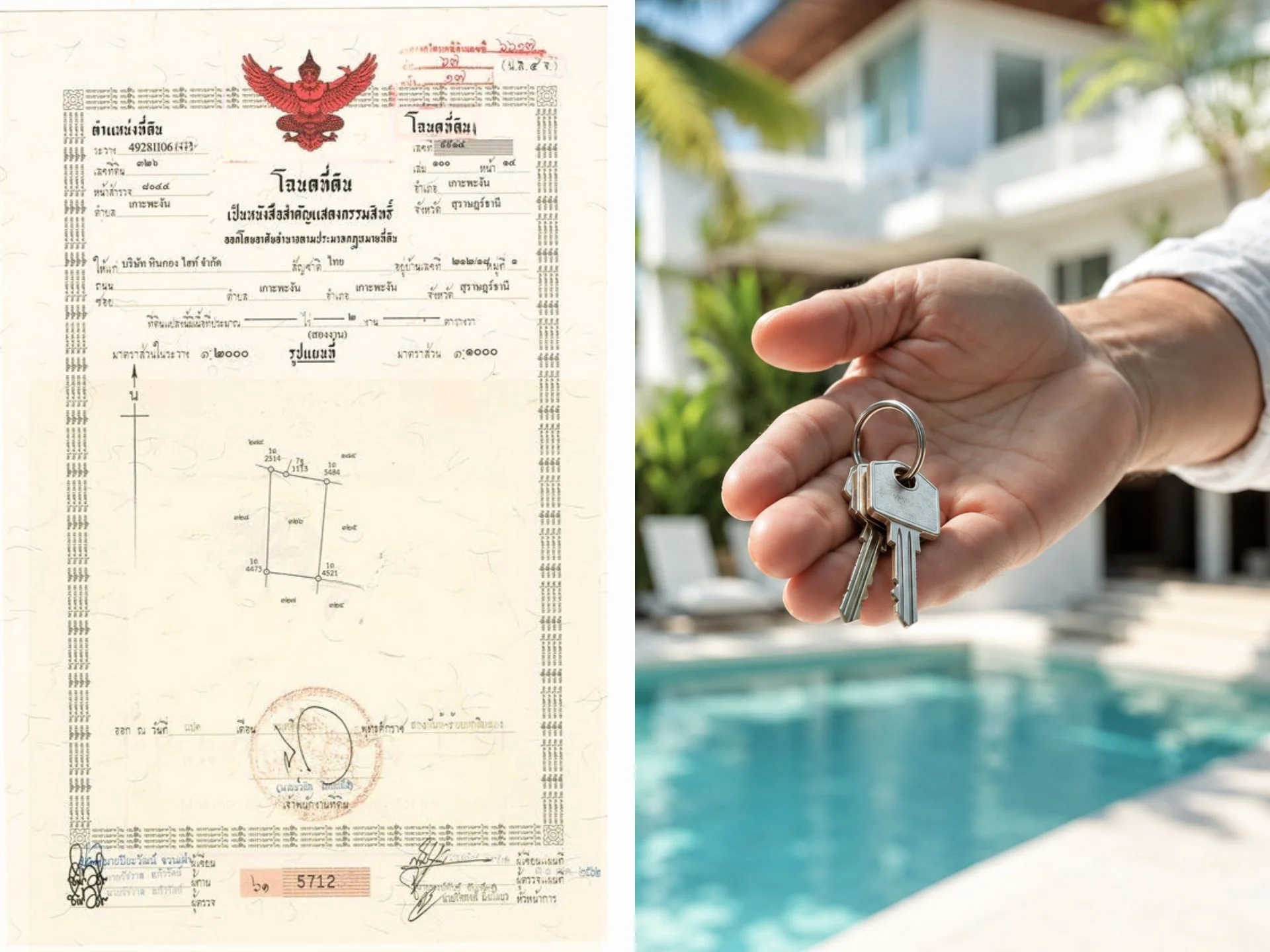
Freehold in Thailand works much like owning a flat or house back home. Your name goes on the state register and you receive a title deed for the unit (Condominium Title Deed). You can let it, sell it, mortgage it, give it away or leave it to your heirs. There is no time limit.
Leasehold is a long-term lease registered with the state. The landowner or building owner keeps ownership, and you acquire the right to use the property for up to 30 years. Because the lease is on the register, it stays in force even if the owner sells the land.
Why two systems? The Land Code does not allow foreigners to buy land. Apartments are the exception: a foreigner can own a unit outright if the building has free foreign quota. Everything else, from a villa to an apartment outside the quota, a foreigner holds on a lease.
3. Freehold: what a foreign buyer gets
The right of foreigners to buy apartments comes from the Condominium Act of 1979 (B.E. 2522). The buyer owns the unit and becomes a co-owner of the building's common property: the pool, lobby, car park and the land the building stands on.
Three conditions for buying freehold
The building is registered as a condominium and holds a Land Department licence.
The unit falls within the foreign quota: foreigners together may own no more than 49% of the total floor area of all units (Section 19 bis of the Condominium Act).
The purchase money has come from abroad (Section 19, paragraph 5).
The third condition is the one buyers most often get wrong, so we cover it separately.
The FET form: how to send money for your apartment
The law accepts three sources of funds for freehold: foreign currency transferred into Thailand, money from a Non-Resident Baht Account, and money from a foreign currency account. The Thai bank that receives the transfer confirms it in writing. For transfers of $50,000 or more, the bank issues a Foreign Exchange Transaction Form (FET, formerly known as Thor Tor 3). For smaller amounts it issues a credit advice, which the Land Department also accepts.
What we check on every KVARIS transaction:
the payment reference states the unit number, project name and the buyer's name exactly as in the passport;
the confirmed transfers together cover the full purchase price;
if someone other than the buyer sends the money, we agree the arrangement with the developer and the bank before the first payment;
an ordinary baht transfer between two Thai accounts does not qualify for freehold.
Without this confirmation the Land Department will not register the unit in a foreigner's name, even if the developer has already received the money.
The 49% quota: how to check it before you reserve
On a new development, the developer tracks the quota and states upfront which units are offered freehold. On the resale market, the condominium's Juristic Person Office confirms how much quota remains. Before you reserve, ask for written confirmation that your unit falls within the foreign quota. If the quota is used up, the same unit will be offered to you as leasehold.
A proposal to raise the quota to 75% has been under discussion since 2023 but has not become law. The 49% limit still applies.
Your share of the land under the building
A freehold buyer does not receive a separate plot. Instead, the apartment owner becomes a co-owner of the condominium's common property, and the land under the building is part of it. The share is tied to the apartment: it cannot be sold separately and passes to the next owner together with the unit.
How much more freehold costs than leasehold
From a developer, a freehold apartment costs more than the same unit on leasehold, because the buyer pays for a place in the foreign quota. Each developer sets this premium. One real example: a quota price of ฿10,000 (€266 / $296) per sqm, so on a 30 sqm (323 sq ft) studio priced at ฿3,345,000 (€89K / $99K) the premium is ฿300,000 (€8.0K / $8.9K), about 9% of the price. We give the exact figure for each unit together with your shortlist.
4. Leasehold: a 30-year lease
Section 540 of Thailand's Civil and Commercial Code limits a single property lease to 30 years. Leases longer than three years must be registered at the Land Department (Section 538). An unregistered lease is enforceable for three years only.
What a registered lease protects
your right to use the property for the full term, even if the owner sells the land or the unit;
subletting and assignment, where the contract allows them;
resale through an assignment of the lease with fresh registration;
payment without an FET: leasehold money can be sent by any lawful means;
lower transfer costs: 1.1% of the contract value.
Buyers often ask us whether leasehold is "just renting" and whether the landowner could take the house back. A registered lease gives the owner no such right. It can be ended early only on the grounds set out in the contract and the law, such as non-payment. That is why the lease should be read before you reserve, not afterwards.
30+30+30 renewals after the Supreme Court ruling
In Decision No. 4655/2566, Thailand's Supreme Court held that renewals beyond 30 years agreed in advance do not oblige the owner to grant them. The first 30 years of a registered lease remain valid. Any renewal after that is negotiated again and registered as a new contract.
What this means for a buyer:
treat a leasehold as a 30-year term, and any renewal as an option still to be agreed;
find out who owns the land: the developer, a Thai company or a private individual;
set out in the contract what happens to the building and furniture when the lease ends.
A bill to allow 99-year leases was discussed in 2024 and 2025 but has not become law. The maximum term of a single lease is still 30 years.
A note on investment horizon. An investor who plans to hold for 5 to 10 years sells long before the lease runs out, and the next buyer takes over the remaining 20 or 25 years. The shorter the remaining term, the lower the resale price, so factor this into your yield calculation.
Resale and inheritance
A leasehold apartment is sold by assigning the lease, with registration at the Land Department. Before buying, check two clauses: whether the owner's consent is needed for an assignment, and whether the owner charges a fee for it.
Inheritance is less straightforward. Thai courts treat a lease as a right tied to the person of the tenant. Contracts therefore include a clause transferring the lease to heirs, and a lawyer should review its wording: it works as an obligation of the owner, not as automatic inheritance.
5. Villas in Thailand: who owns the land and the house
A foreign buyer owns the house and leases the land beneath it. The two are legally separate. Ownership of the building is created through a superficies right (Sections 1410 to 1416 of the Civil and Commercial Code): the landowner allows the buyer to own a house on the plot, and the Land Department registers that right. The land stays with its owner; the house belongs to the buyer.
Before a villa purchase is registered, check:
the land title: a Chanote (Nor Sor 4 Jor) fixes the plot's exact boundaries and is the most secure title;
who owns the plot and whether it carries a mortgage or a seizure order;
the length of the land lease and the terms for renewing it;
registration of the superficies over the house;
what happens to the house when the land lease ends;
any annual ground rent the project charges.
We agree the terms and costs of a villa purchase with the developer before you reserve.
Can a foreigner buy land in Thailand?
Yes, in one narrow case. Section 96 bis of the Land Code allows a foreigner to buy a residential plot under these conditions:
an investment in Thailand of at least ฿40 million (€1.06M / $1.18M), in Thai government bonds, property funds, shares in a BOI-promoted company or foreign currency brought in for investment;
the investment is held for at least 5 years and reported annually;
the plot is no larger than 1 rai (1,600 sqm / 17,222 sq ft), in a residential zone and outside military areas;
the purchase is approved by the Minister, and the house is used as the buyer's family home.
If the conditions are breached, the Land Department orders the plot to be sold. In practice this route is rarely used.
Why we advise against Thai company structures
A Thai company may own land. But if its Thai shareholders are nominees and the company exists only to get around the ban, the arrangement breaks the law. In 2026 the Department of Business Development (DBD) began checking the source of funds when companies are set up (from 1 January) and when shareholders change (from 1 April), and the Land Department gained access to shareholder data. If such a structure appears in a deal, have the company and the rights to the property checked separately by a Thai lawyer.
6. Freehold vs leasehold in Thailand: side by side
Freehold
Leasehold
Legal nature
Ownership
Registered lease
Term
Permanent
Up to 30 years per contract
Key document
Condominium Title Deed
Lease registered at the Land Department
What you can hold
A condominium apartment within the 49% quota
An apartment, villa, house or land
Renewal
Not needed
New contract and new registration, if the owner agrees
Inheritance
Under general inheritance rules
Through a contract clause, reviewed by a lawyer
Resale
Free sale with registration
Assignment of the lease on the contract's terms
Purchase funds
From abroad, with an FET or bank credit advice
Any lawful means
Transfer costs
Up to 6.3% of the price, split as agreed
1.1% of the contract value
Price
Higher by the cost of the quota
The project's base price
7. How much the transfer costs
Rates are the same for Thais and foreigners. Who pays what is set by the contract, so agree the split before you sign the reservation.
Payment
Rate
Basis
When it applies
Usually paid by
Transfer fee
2%
Land Department appraised value
Transfer of ownership (freehold)
As agreed, often split 50/50
Specific Business Tax
3.3%
Higher of sale price and appraised value
Seller has owned the property for less than 5 years
Seller
Stamp duty
0.5%
Higher of sale price and appraised value
Instead of Specific Business Tax, where that does not apply
Seller
Withholding tax
1% for a company; formula-based for an individual
Company: higher of the two values; individual: appraised value
Every sale
Seller
Lease registration
1%
Total rent for the full term
Leases over 3 years
As agreed
Stamp duty on the lease
0.1%
Total rent for the full term
Leases over 3 years
As agreed
A seller is exempt from Specific Business Tax after owning the property for 5 years or more, after inheriting it, or after being listed in the house registration book at that address for at least a year. Stamp duty of 0.5% is then paid instead.
The 0.01% fee reduction: who qualifies
From 1 July 2026 to 30 June 2027, the transfer fee and the mortgage registration fee are cut to 0.01% for homes priced up to ฿7 million (€186K / $207K). The reduction applies only to buyers with Thai citizenship. A foreigner registering an apartment in their own name pays the standard 2%.
Worked example: an apartment at ฿10,000,000 (€266K / $296K)
For clarity, we assume an appraised value equal to the sale price. In practice the Land Department's appraisal is often below market price, so the actual payments are lower.
Payment
Freehold from a developer
Freehold resale, seller owned 3 years
Freehold resale, seller owned 6 years
Leasehold, 30 years
Transfer fee, 2%
฿200,000 (€5.3K / $5.9K)
฿200,000 (€5.3K / $5.9K)
฿200,000 (€5.3K / $5.9K)
none
Specific Business Tax, 3.3%
฿330,000 (€8.8K / $9.8K)
฿330,000 (€8.8K / $9.8K)
none
none
Stamp duty, 0.5%
none
none
฿50,000 (€1.3K / $1.5K)
none
Withholding tax
฿100,000 (€2.7K / $3.0K), 1%
฿227,500 (€6.0K / $6.7K)
฿360,000 (€9.6K / $11K)
none
Lease registration, 1%
none
none
none
฿100,000 (€2.7K / $3.0K)
Stamp duty on the lease, 0.1%
none
none
none
฿10,000 (€266 / $296)
Total
฿630,000 (€17K / $19K), 6.3%
฿757,500 (€20K / $22K), 7.6%
฿610,000 (€16K / $18K), 6.1%
฿110,000 (€2.9K / $3.3K), 1.1%
Buyer's share if the transfer fee or lease registration is split 50/50
฿100,000 (€2.7K / $3.0K)
฿100,000 (€2.7K / $3.0K)
฿100,000 (€2.7K / $3.0K)
฿55,000 (€1.5K / $1.6K)
How the individual seller's tax is calculated for 3 years of ownership: a 77% deduction for the holding period leaves a taxable base of ฿2,300,000 (€61K / $68K), or ฿766,667 (€20K / $23K) per year; tax at progressive rates comes to ฿75,833 (€2.0K / $2.2K) a year, or ฿227,500 (€6.0K / $6.7K) for 3 years. The Land Department makes the final calculation on its own appraisal, so ask the seller or a lawyer for the figure before the transfer.
On Phuket, a common arrangement with developers is that the developer pays the Specific Business Tax and withholding tax, and the transfer fee is split 50/50. The buyer then pays ฿100,000 (€2.7K / $3.0K), or 1% of the price. For leasehold both arrangements are common: the 1.1% is either split or paid entirely by the buyer.
Taxes after purchase, including the annual land and building tax, are covered in our article Property taxes in Thailand.
8. Which to choose for living, letting or resale
Goal
Option
Why
Living there yourself, second home
Freehold
Permanent right, simple resale and inheritance
Leaving the property to your children
Freehold
Inheritance under general rules
Investment over 5 to 10 years
Leasehold or freehold
Leasehold costs less to buy into, freehold is easier to resell
Letting through a management company
Either
Rental programmes work the same for both
Villa with land
Land lease plus ownership of the house
Foreigners cannot own land outright
Ownership type has no effect on rental yield: tenants do not care how the apartment is held. The difference shows when you buy, where leasehold is cheaper in both price and fees, and when you sell, where freehold is easier to resell because the buyer gets ownership with no time limit.
9. Checklist before you buy
New development: the condominium licence, the developer's title deed for the land and written confirmation of quota for freehold.
Resale: due diligence by a Thai lawyer (title, encumbrances, arrears on service charges).
Every item in the cost table: who pays it, and whether the split is written into the contract.
Leasehold: term, renewal terms, assignment, inheritance and what happens to the building when the lease ends.
Freehold: the payment route and FET confirmation agreed before the first payment.
Running costs: service charge, sinking fund and utilities.
This material is for information purposes. Before proceeding with a transaction, verify current rates and requirements with a Thai solicitor; Land Department regulations and practice change.
Author: KVARIS press office
FAQ
01
What is freehold in Thailand, in simple terms?
Freehold is full, permanent ownership: the buyer's name goes on the Land Department register, and the apartment can be sold, let or left to heirs. A foreigner can buy a condominium apartment freehold if the building has free foreign quota.
02
Can a foreigner own property in Thailand?
Yes. A foreigner can own a condominium apartment outright within the 49% quota, and can own a villa house through a superficies right. The land under the house is held on a lease of up to 30 years.
03
Can I pay for a freehold apartment from my UK or EU bank account?
Yes. An international transfer in foreign currency from your account abroad is exactly what the law requires, and the receiving Thai bank issues an FET form or a credit advice for it. State the unit number, project name and your passport name in the payment reference.
04
Can I convert leasehold to freehold later?
Yes, if the building has free foreign quota and the developer agrees. You pay the quota premium, transfer the money from abroad with an FET and pay the transfer costs. Ask for this option to be written into the contract before you buy.
05
What happens to a leasehold apartment after 30 years?
The first lease term ends, and continuing requires a new contract with the owner and a new registration. Renewals agreed in advance do not bind the owner, as Thailand's Supreme Court has confirmed.