Article about freehold and Leasehold in Thailand: how to register property as a foreigner
Freehold and Leasehold in Thailand: how to register property as a foreigner
What property can a foreigner register in full ownership and how do you register a land plot when purchasing a villa? We analyse how the Freehold and Leasehold ownership forms differ in practice.
Freehold and leasehold in Thai property listings are not marketing labels, but two different legal instruments. They are registered differently at the Land Department, provide different sets of rights, operate for different periods and open different exit scenarios from the transaction.
For a foreign buyer, the choice between freehold and leasehold depends on the purpose and laws. Under the Land Code, a foreigner cannot purchase land as their own property, so land plots under villas are purchased on a leasehold basis: there is no other lawful way to acquire a plot. With an apartment in a condominium, there is more freedom, both forms are available. And this decision affects the entry price, the amount of fees at registration and how the property will be sold further.
What freehold gives and who has access to it
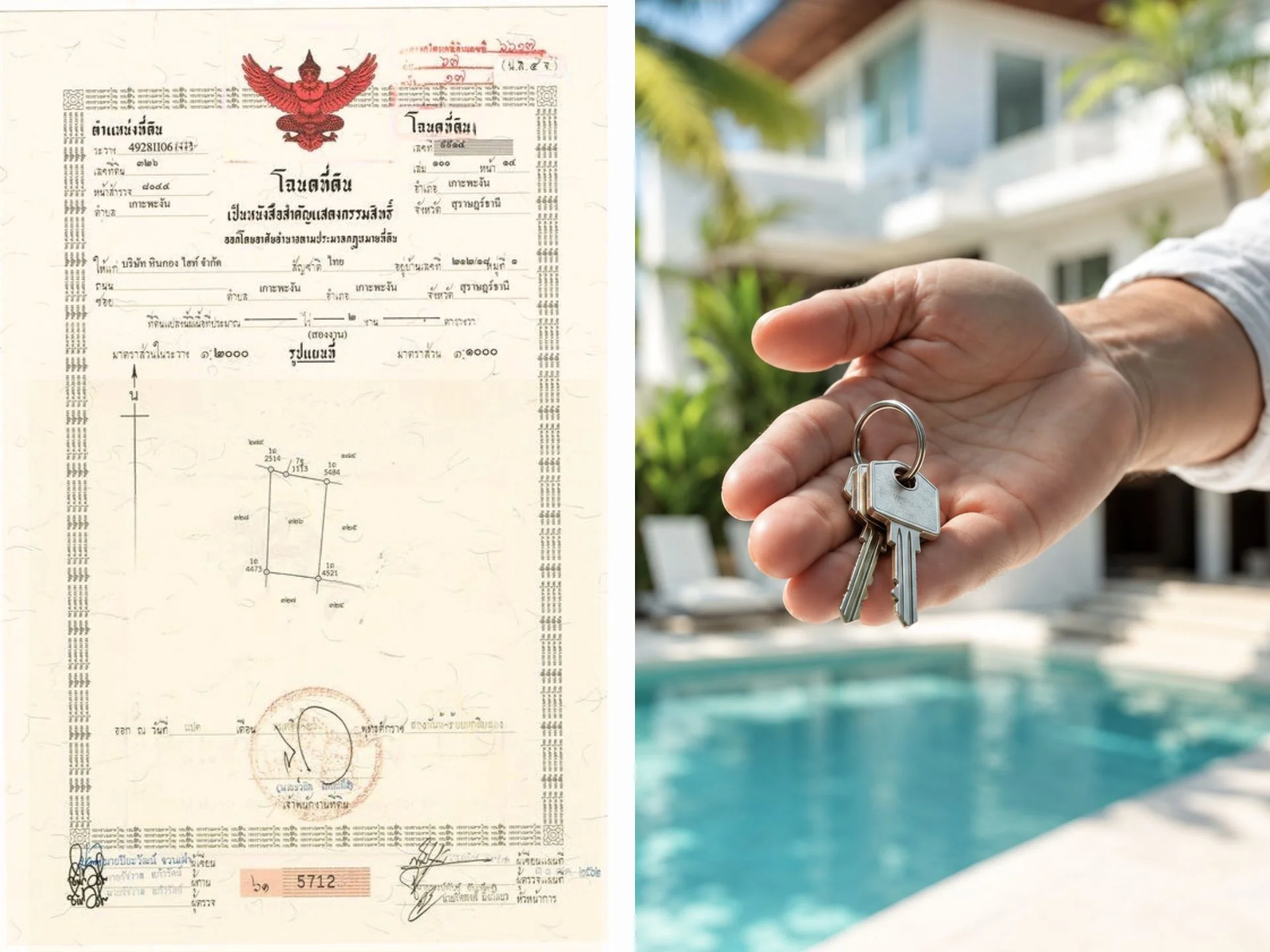
Freehold means perpetual ownership right: to own, use, rent out, pledge, sell and pass on by inheritance. The owner's name is entered in the Land Department register, and the buyer receives a title deed for the apartment (Condominium Title Deed).
The right of foreigners to purchase apartments was established by the Condominium Act 1979 (Condominium Act B.E. 2522). It operates under three conditions:
the building is registered as a condominium and has a license from the Land Department;
the apartment is located within the foreign quota of the building;
the money for the purchase came from abroad in foreign currency.
The third condition is most often overlooked. The Land Department requires the FET form (Foreign Exchange Transaction Form, formerly called Thor Tor 3). A Thai bank issues it when transferring from 50,000 USD; for smaller amounts, it issues a bank letter or credit note. In the payment purpose, specify the apartment number, project name and buyer's name according to passport. Without FET, the transaction will not be registered, even if the money has already arrived in Thailand.
Section 19 bis of the Condominium Act limits aggregate foreign ownership to 49% of the total saleable floor area of the building.
Leasehold: term, renewal and what happens after 30 years
Leasehold means a registered right of use for a period of up to 30 years, based on Article 540 of the Thai Civil and Commercial Code. A contract longer than three years must be registered at the Land Department, otherwise it remains in force only for the first three years.
What registered lease allows:
use of the property for the entire term of the contract, regardless of change of owner;
subletting and assignment of rights, including sale on the secondary market, if provided for in the contract;
passing of rights to heirs when the corresponding clause is included in the contract;
access to land and villas, which a foreigner cannot formalise in their own name;
costs of formalisation are substantially lower than with freehold.
For a villa, the land is leased, and the building itself is formalised as a separate ownership right (superficies, Articles 1410-1416 of the Thai Civil and Commercial Code). The house thus belongs to the buyer, not the lessor.
What to check:
option to renew at the tenant's initiative instead of automatic renewal
separately formalised ownership right to the building
lessor's obligation to re-execute the contract for a new term and sanctions for refusal
For a new renewal term under the 30+30+30 scheme, participation of the original owner, a new agreement and registration are required.
Separately about investment horizon. If you plan to hold the property for 5–10 years, the difference between 30 and 90 years does not affect the yield: the apartment goes to the secondary market long before the end of the first term, and the next buyer receives the remainder of the lease of 20–25 years. Leasehold works as an investment tool precisely in this logic, not as a way to pass the property on to grandchildren.
Comparison of freehold and leasehold
Parameter
Freehold
Leasehold
Legal nature
Ownership right
Registered right of use
Term
Perpetual
30 years under one contract
Primary document
Title deed for apartment
Lease agreement + title deed
Available properties
Apartments in condominium within 49% quota
Apartments, villas, land plots
Inheritance
Yes, under general rules
Yes, if included in the contract
Sale on the secondary market
Free
Assignment of rights, terms per contract
Renewal
Not applicable (perpetual)
New agreement and registration required
FET requirement
Mandatory
Not required
Formalisation costs
Up to 6.3% of transaction price
1.1% of contract sum
Property price
Usually 10% higher
Base project price
How much formalisation costs
Rates are the same for Thais and foreigners. The law does not determine who pays: the distribution is fixed in the contract.
Payment
Rate
Calculation basis
When applied
Transfer Fee
2%
Appraised value
Always when transferring ownership
Special Business Tax (SBT)
3.3%
Larger of: appraised or sale price
Seller owned for less than 5 years
Stamp Duty
0.5%
Registration value
Instead of SBT, if ownership over 5 years
Withholding tax on income
Progressive scale
Appraised or sale price
Always when transferring ownership
Lease agreement registration
1%
Rental sum for entire term
Leasehold longer than 3 years
Lease Stamp Duty
0.1%
Rental sum for entire term
Leasehold longer than 3 years
Maximum for freehold is the sum of three items: 2% + 3.3% + 1% = 6.3% of transaction sum
Example calculation: apartment for 10,000,000 ฿
Payment
Freehold new-build
Freehold, secondary market
Leasehold for 30 years
Transfer Fee, 2%
200,000 ฿
200,000 ฿
no
Special tax, 3.3%
330,000 ฿
330,000 ฿
no
Withholding tax on income, 1%
up to 100,000 ฿
up to 100,000 ฿
no
Lease registration, 1%
no
no
100,000 ฿
Lease Stamp Duty, 0.1%
no
no
10,000 ฿
Total on transaction
630,000 ฿ (6.3%)
up to 630,000 ฿ (6.3%)
110,000 ฿ (1.1%)
Seller pays
530,000 ฿
315,000 ฿
if split 50/50 – 55,000
Buyer's share if split 50/50
100,000 ฿
315,000 ฿
55,000 ฿
Developers on Phuket commonly use an arrangement where the special tax and withholding tax are borne by the seller, and the transfer fee is split equally: the buyer pays 100,000 ฿, or 1% of the price. But there is a nuance – freehold apartments from a developer cost more than leasehold.
On the secondary market between two private parties, the entire package is usually split equally, and the buyer pays 315,000 ฿. With leasehold, both variants are found: either a 50/50 split or the entire 1.1% charged to the buyer.
All three scenarios need to be settled by asking the developer or seller one question before signing the reservation.
Timescales. Registration itself at the Land Department takes one working day for both forms. Preparation of the freehold package, including obtaining FET, takes 5–15 working days. With leasehold, agreement on the contract text takes longer: allow 2–4 weeks.
Tax obligations of the owner after the transaction, including annual Land and Building Tax, are covered in the article Property taxes in Thailand.
What to choose for living, for rental, for resale
Purpose of purchase
Recommended form
Why
Permanent residence, second home
Freehold
Perpetual ownership, simple inheritance
Passing to children
Freehold
Inheritance under general rules
Investment with a 5–10 year horizon
Leasehold
Lower entry threshold and registration costs
Renting out via a property management company
Either
Management programme works the same for both forms
Land plot + villa
Leasehold – land Freehold or leasehold – house
Land as own property is not available to foreigners
The form of ownership does not affect rental yield: a tenant does not care which right the apartment is formalised under. The difference appears at entry, where leasehold is cheaper both in property price and in registration fees, and on exit, where freehold is more liquid when selling to a Thai buyer.
Checklist before the transaction:
For new-builds – request the condominium licence and the title deed to the land from the developer.
For resale property – arrange a Due Diligence review with a Thai lawyer: title, encumbrances, project documentation.
Find out who pays each item in the fees table, and enter this in the contract.
Read in the lease agreement the clauses on renewal, assignment and inheritance.
Obtain FET when purchasing freehold.
Clarify all additional payments for the chosen property.
This material is for information purposes only. Before a transaction, check current rates and requirements with a Thai lawyer: subordinate legislation and the practice of the Land Department change.
FAQ
01
Can leasehold be converted to freehold?
Only if a foreign quota has become available in the building and the developer is willing to carry out the conversion. Such an option is rarely included in contracts; you should ask before the transaction.
02
What will happen to Leasehold apartments after 30 years?
The initial term will expire and a new agreement with the owner will need to be concluded. A renewal option gives grounds to demand this in court.
03
Can you sell a leasehold apartment?
Yes. The rights under the agreement are transferred to the buyer with registration at the Land Department. Check two points: whether the landlord\'s consent is required and whether they charge a commission for re-registration.
04
To buy property in Thailand, do you need an account with a Thai bank?
It is not strictly necessary: freehold funds can be transferred to the developer\'s account when purchasing a new building or to a lawyer\'s account when purchasing on the secondary market. Your own account simplifies obtaining a Residence Permit and paying maintenance fees.
05
What is more expensive to maintain?
Neither one. The Maintenance Fee, utility charges and annual Land tax and Building tax are calculated identically for both forms.